Etude
- Compositeur
- Frédéric François Chopin
- Type
- Étude
- Opus
- Op. 10/6
- Tonalité
- Mi bémol mineur
- Instruments
- Piano
- Cycle
- 12 Etudes, Op. 10
Partitions gratuites
 ♪
♪- Original version
- Piano
Achetez les éditions imprimées
We have selected some printed editions we think may be useful.
- Etudes - Opus 10, 25 & 3 Etudes
- $10.99
- Piano Solo
- G. Schirmer
- Etude Op. 10 #12
- $3.95
- Piano
- G. Schirmer
- Etude, Op. 10, No. 3 In E Major
- $3.95
- Piano Solo
- G. Schirmer
- Complete Preludes And Etudes For Solo Piano
- $12.95
- Piano Solo
- Dover Publications
- Etudes (Mikuli)
- $10.99
- Piano Solo
- G. Schirmer
- Great Piano Etudes: Masterpieces by Chopin, Scriabin, Debussy
- $14.95
- Piano
- Dover Publications
- Etudes
- $24.00
- Piano Solo
- Edition Peters
À propos de
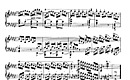
Étude Op. 10, No. 6, in E♭ minor, is a study for solo piano composed by Frédéric Chopin in 1830. It was preceded by the relative key. It was first published in 1833 in France, Germany, and England as the sixth piece of his Études, Op. 10. The tempo Andante in 68 and con molto espressione indicate a more moderate playing speed than Chopin's other études with the exception of Op. 10, No. 3 and Op. 25, No. 7. This étude focuses on expressivity and chromatic structuring of the melody as well as polyphonic texture.
The above text from the Wikipedia article "Étude Op. 10, No. 6 (Chopin)" text is available under CC BY-SA 3.0.
The above text from the Wikipedia article "Étude Op. 10, No. 6 (Chopin)" text is available under CC BY-SA 3.0.